Romanian citizenship is popular among those who wish to live and work all around Europe, travel without visas, have better access to education and enter the EU. The good news is that Romania has the most flexible processes for obtaining citizenship in all EU states. Whether you are applying for citizenship by naturalisation, marriage, restoration, or descent, obtaining the necessary paperwork is one of the most important steps in the process.
But before any of these doors may open, every successful candidate has to overcome one essential hurdle: the preparation of a full and properly legalised file of legal documents. One missing certificate, one old-fashioned extract or one uncertified translation is enough to have an entire application rejected before it is even considered.
The paperwork you need totally depends on the route you’re applying through. The file of a person obtaining citizenship through a Romanian grandparent is considerably different from that of someone naturalising after years of residing in the country. In this complete guide, HA Group shares all the paperwork required for a Romanian citizenship application in 2026 for every route.
First, Identify Your Route
Romanian citizenship is usually granted in one of the following ways. Your document list is based on your response.
- By descent (ancestry): One of your parents, grandparents or great-grandparents was a Romanian citizen or was born in an area that was Romanian territory at that time.
- By reacquisition (Restoration): You or your forefathers were Romanian citizens, lost your citizenship, and now want to regain it.
- By naturalisation: You are a foreign national who has legally resided in Romania for a sufficient period to be eligible.
- By marriage: Spouses of Romanian citizens who meet the requirements for a reduced residency timeframe.
The Core Documents Every Applicant Needs
No matter what path you choose, a basic set of documents appears in almost every file;
- Valid identity and travel documents: your current passport (valid, with certified copies), or any national ID card. Originals are normally returned; certified copies are kept.
- Civil-status papers: Minimum your birth certificate, plus marriage, divorce or death certificates as necessary. Extracts have to be current originals, apostilled and translated.
- Application form: Form is filled in Romanian, often in person at submission. If you do not speak Romanian well, it is highly encouraged to bring a representative.
- Criminal record certificates: A clean criminal record from Romania and from every nation you resided in lately, apostilled or super-legalised and translated. Applications for serious crimes can be rejected completely.
- Recent photos: Usually require four colour photos, 3.5 cm × 4.5 cm. First, check the latest consulate requirements.
- Proof of fee payment: Proof of payment of charge – processing expenses are paid in Romanian leu; keep all invoices. Declaration costs are typically a few hundred Euros for adults and less for youngsters.
Additional Documents by Pathway
Documents for Citizenship by Descent
If you are applying for citizenship based on bloodline, your main goal is to provide a continuous chain of evidence from you through each generation to your Romanian ancestor. If one link is absent or unclear, the chain is broken, and the authorities consider the familial connection unsubstantiated.
- Legalised copies of the original birth, marriage and death (if necessary) certificates of your Romanian ancestor, each with a legalised translation.
- Documentary proof of the chain of ancestry from that ancestor to you, generation by generation. Your grandparents’ or great-grandparents’ birth certificate anchors the family to Romania.
- Archival documents, if current certificates are not available, from Romanian state archives, church parishes or municipal offices.
- The certificate of loss of citizenship or formal confirmation of withdrawal if your ancestor lost their status.
Language note: In general, a B1 level of Romanian is expected, while waivers are usual for persons recovering lost citizenship and descendants who are 65 or older at the time of application.
Documents for Citizenship By Naturalisation
The longest route, with paperwork that shows a higher standard of real integration:
- Proof that you have been legally living in Romania for the required time period, such as your residence permit and any extensions (renewal).
- Proof of a regular income and a way to live, like a job contract, salary slips, ANAF tax returns, business ownership proof, or bank records.
- A property title or rental agreement is proof that you have a place to live in Romania.
- Evidence of your ability to communicate and understand the Romanian language at approximately B1 level, or an accepted waiver, such as a Romanian university title.
- A written statement of loyalty that says you have never done anything to hurt the Romanian government, the rule of law, or national security.
By Marriage
Marriage reduces the residency, but you must prove that the relationship is real and ongoing:
- Your marriage certificate to the Romanian citizen was properly legalised and translated.
- Proof of your spouse’s Romanian citizenship.
- Evidence of cohabitation and a real shared existence, generally for a minimum number of years before applying.
- All applicants are required to provide the same basic set of documents on ID, civil status, criminal record and income.
By Reacquisition (Restoration)
Former citizens who want to reclaim their citizenship must provide solid proof of their former citizenship:
- Proof of your previous Romanian citizenship and the circumstances in which it ceased to exist.
- Civil status documentation linking your current identification to your past citizenship.
- Clean criminal record and the required core papers.
Documents Required for Minor Children
Requires additional documents:
- Child’s birth certificate & passport
- Parent identification documents
- Parental consent form & custody documents (if applicable)
Officials examine these documents to ensure that family law requirements are being complied with.
The 2026 Game-Changer: Language Requirement
One recent change has surprised many candidates. As a result of changes to the citizenship laws, understanding the Romanian language is now mandatory for all types of citizenship, not just naturalisation. This applies to cases of descent and reacquisition.
Applicants are typically required to provide a language competency certificate from a recognised institution and, in certain cases, to pass an interview evaluating their knowledge of the language, history, geography, culture and constitution. Some categories tend to be ignored – former citizens re-applying, applicants 65 and older, and youngsters included in a parent’s paperwork.
Authentication and Translation: Where Files Fall Apart
Regardless of the route you select, there are two important steps that must be taken for your application to function.
Legalisation or Apostille
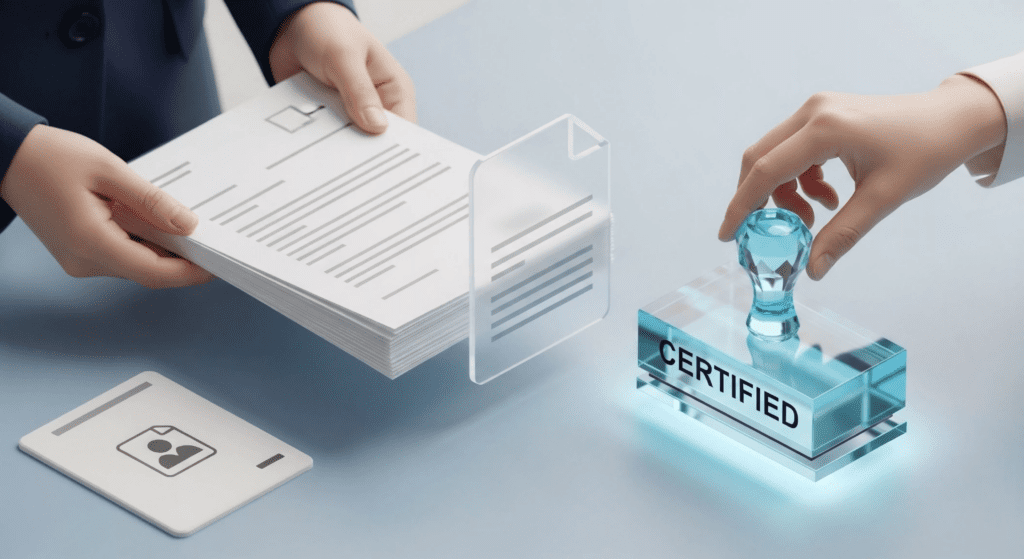
Every foreign publication must be considered. It requires an apostille if it is from a nation which is a signatory of the Hague Apostille Convention. Otherwise it has to be superlegalised at a Romanian consulate. Files without proper authentication will be refused outright.
Certified translation
For official documents that are not in Romanian, a qualified translator and a notary public are required. People keep getting caught on this: Even a poorly done version that is 100% correct will be rejected.
How the File Is Submitted
Applications can’t be sent by mail, fax, or email; they have to be turned in in person. This is because fingerprints and a picture of the applicant’s face are needed to identify them. You can file at either a Romanian NAC office or a Romanian embassy or consulate near your home, based on how you plan to get there. A lot of people have to book a meeting online first.
Common Mistakes That Cause Rejections
- Submission of expired certificates of civil status or criminal record
- Using unofficial or self-made translations.
- Not to submit the apostille or super-legalisation to one or more documents.
- A gap in the chain of descent, no archival backup.
- Naturalisation paperwork provides no proof of income and housing.
- Coming without the linguistic ability to complete the Romanian form.
- Different names in different papers, with no deed or affidavit to verify they pertain to the same individual
FAQs
How long does the process take?
It depends. Cases of descent usually take a year or two to handle, but the process of becoming a citizen takes much longer.
Can I maintain my old citizenship?
Yes, Romania accepts dual nationality, so you don’t have to give up your existing nationality, but it’s vital to know your country of origin’s stance.
Do my children need to apply on their own?
Instead of a separate application, a parent’s application often includes their young children under less strict rules.
What if an old record is missing?
If you need Moldovan documents, you could obtain archival copies or records through the civil office or court system. The authorities decide if other proof is enough.
Ready to Start Your Romanian Citizenship Journey?
At HA Group, we help applicants gather compliant, fully legalised citizenship documentation for all paths; descent, naturalisation, marriage and restoration. If you want your documents evaluated and your chain of descent checked before spending your valuable time and money, contact our team and apply with confidence.
Disclaimer: This article is for general information only and does not constitute legal advice; always verify current requirements with the National Authority for Citizenship or a qualified Romanian immigration professional before applying.
Recommended Articls:
What is Romanian Citizenship By Descent, and Who Qualifies?
Can I Get Greek Citizenship Through a Golden Visa?
Can I Rent Out Property With Greece Golden Visa?
Who Is a Licensed Liquidator in the UAE and How to Appoint One?
Why is VAT Filing Important for Small Businesses in the UAE?