The easiest UAE bank account for a non-resident in 2026 is ADCB’s Instant Tourist Account. You open it on your phone in a few minutes, with no opening deposit and nothing to hand over but your passport. If you need something that lasts longer than a holiday, Emirates NBD, Mashreq and RAKBANK are the most reliable choices, though each wants a branch visit and a real balance. Here is how the two routes compare, what each one costs, and which fits your situation.
Which UAE banks open accounts for non-residents in 2026?
Seven banks handle non-resident personal accounts with any regularity: ADCB, Emirates NBD, Mashreq, RAKBANK, Dubai Islamic Bank, First Abu Dhabi Bank and HSBC UAE. They are nowhere near equally easy to get into.
The split that matters now is between a short-term digital account you open yourself and a long-term savings account that goes through a compliance team.
| Bank | What you can get | How you open it | Best suited to |
| ADCB | Instant Tourist Account: AED savings, digital debit card | Mobile app, minutes, no branch | Visitors who need spending money and a card |
| Emirates NBD | Non-resident savings, dirhams or multi-currency | Branch visit in the UAE | Property owners, former residents, regular visitors |
| Mashreq | Non-resident savings under Mashreq Gold | Branch visit, then managed online | Savers who want several currencies |
| RAKBANK | Non-resident account inside the Elite tier | Branch visit with a relationship manager | Larger balances, conventional or Islamic |
| Dubai Islamic Bank | Sharia-compliant savings and deposits | Branch visit in the UAE | Anyone who wants Islamic banking |
| First Abu Dhabi Bank | Handled through relationship channels | Introduction or referral | Existing clients and investors |
| HSBC UAE | International account for existing HSBC customers | Referral from your HSBC bank at home | People already banking with HSBC abroad |
First Abu Dhabi Bank builds its retail accounts for UAE nationals and residents, so a non-resident normally comes in through a relationship manager rather than a standard application. HSBC works in a similar way. Your existing HSBC relationship in another country is the door in, and the bank can open an account for you in more than 20 destinations, from inside or outside the UAE.
“Easiest” here comes down to three things: how many documents you need, whether you have to sit in a branch, and how much money you have to leave behind. ADCB now wins on all three, but only for a short-term account. For a permanent one, the field is much closer.
The fastest route in 2026: ADCB’s Instant Tourist Account
On 30 April 2026 the Central Bank of the UAE, the Federal Authority for Identity, Citizenship, Customs and Port Security (ICP) and ADCB launched the Tourist Identity initiative. When you clear immigration, ICP creates a verified digital identity for you using biometrics and facial recognition. That identity connects to ADCB’s mobile app, and you can open a bank account from your hotel room in a few minutes.

The account is deliberately simple. The ADCB Instant Tourist Account is an AED savings account with no minimum opening amount. A digital debit card is issued straight away and you switch it on in the app. The card works inside the UAE for ATM withdrawals, shop purchases, online payments and digital wallets. The account also links you to Jaywan, the national card scheme, and Aani, the instant payment platform, so you can pay the way residents do.
The cost is AED 25 a month, and that disappears if you keep AED 2,500 in the account. Opening it takes four taps: download the ADCB Mobile Banking App, choose “New to ADCB? Start your journey”, pick Accounts, then select the Instant Tourist Account. If you would rather have a plastic card than a digital one, you can request it at a uBank kiosk for an issuance fee.
The limits are worth knowing before you start:
- You must be 18 or older, physically in the UAE, and on a valid tourist or visit visa. A 96-hour visa or a transit visa will not qualify.
- It is temporary. The account closes when you exit the country, when your visit visa runs out, or after six months, whichever comes first. There is a seven-day grace period.
- It cannot be a joint account, and it cannot be converted later. Get a UAE residence visa and you close this one, then open a normal account.
- To move money out of the UAE you register one international account in your own name. Whatever is left when the account closes goes there.
- While the account is open you cannot hold any other ADCB product.
If you want a UAE card and a local IBAN for a trip, this is now the shortest path by a wide margin. If you want an account that will still be there next year, read on.
The traditional route: a non-resident savings account
A non-resident account at a traditional bank is a savings account, not a current account. That one fact explains most of what follows. You get a debit card, online and mobile banking, foreign currency options and international transfers. You do not get a chequebook, an overdraft, or a credit card unless you secure it against a deposit. Cheques and credit facilities in the UAE are tied to a residence visa and an Emirates ID, and there is no way around that.
Emirates NBD has the clearest published setup. Its standard savings account pays 0.20% a year, is held in dirhams, and comes with a free international debit card. If you want to hold several currencies in one place, the Currency Passport savings account covers USD, GBP, EUR, CHF, AUD, CAD, JPY, SGD, HKD, JOD and KWD. Transfers to India, Pakistan, the Philippines, Sri Lanka, Egypt and the UK arrive in about 60 seconds through DirectRemit, which matters if you send money home regularly.
Mashreq’s non-resident account sits under Mashreq Gold. It is a savings account, available in the major currencies, with a free debit card and cash access in more than 200 countries. Once it is open you run it online.
RAKBANK puts its non-resident offering inside RAKBANK Elite, its premium tier, so a relationship manager comes with the account. There is a Sharia-compliant version as well. ADCB opens fixed deposits to non-residents from AED 5,000 or the currency equivalent, though you need an active savings account with the bank first. Dubai Islamic Bank covers the Sharia-compliant side for anyone who prefers profit-sharing to interest.
So what can you actually do with one of these accounts? More than the restrictions suggest. You can receive rent from a Dubai apartment, pay utility bills and service charges by standing instruction, settle school fees, hold dirhams without converting every time you visit, and send money out by international transfer. Large transfers from a non-resident account attract more attention than they would from a resident one, so keep the supporting paperwork.
How much money do you need?
Expect AED 25,000 to AED 100,000 for a standard non-resident savings account, and AED 250,000 to AED 500,000 if the bank routes you into priority or private banking. Some profiles are approved for less. No UAE bank publishes one fixed non-resident number, because the threshold is set from your profile after the compliance review, not from a rate card.

The reason the bar sits so high is worth understanding, because it shapes how you should apply. A non-resident account earns the bank very little and costs it a lot to monitor. No salary lands in it, there is no mortgage attached, no credit card, and the customer lives in another country. The balance is what makes the relationship worth keeping.
Three things follow from that. Ask about the fall-below fee as well as the minimum, because dropping under the line usually triggers a monthly charge rather than a warning. Put the money to work while it sits there: a standard savings account pays around 0.20% a year, while fixed deposits in dirhams and dollars pay a good deal more, since the dirham is pegged to the US dollar and UAE deposit rates track it. And if the number you are quoted is out of reach, the tourist account gives you a working UAE IBAN and card for AED 2,500.
What documents do you need?
For the app-based tourist account, a valid passport is the whole list.
For a traditional non-resident savings account, gather these before you fly:
- Your passport, original and copy, showing the UAE entry stamp.
- Proof of your home address. A utility bill works if it shows your full address and is less than three months old.
- Six months of bank statements from your home country.
- A reference letter from your existing bank. Emirates NBD asks for a relationship of at least 12 months.
- Proof of where your money comes from: a trade licence, pay slips, tax returns, company ownership papers or investment statements.
- A short, honest explanation of why you want a UAE account.
That last one carries real weight. “I bought an apartment in Dubai and need somewhere to pay the service charges” is a reason a compliance officer can work with. “The UAE is tax-free” is not.
Two practical points on the paperwork. Anything not in English or Arabic needs a legal translation, and scans have to be clean and complete, including the blank-looking pages of a bank statement. Some banks prefer the reference letter to come straight from your bank rather than in your hand, so ask when you book the appointment.
How the process works, step by step
- Pick your bank and confirm the current terms by phone or email before you travel. Non-resident policies change often, and last year’s figures are not much use.
- Book a branch appointment. Walk-ins are usually turned away for non-resident applications.
- Enter the UAE on a tourist or visit visa. You have to be in the country in person for a traditional account.
- Attend the appointment with your originals. The bank verifies your passport, takes your signature and starts the compliance review.
- Answer follow-up questions quickly. Extra document requests are normal and not a sign that something has gone wrong.
- Fund the account inside the window the bank gives you, which is often seven days.
- Collect your debit card or have it couriered, then register for online and mobile banking.
Plan a stay of five to seven working days. A straightforward file clears in three to five business days after the branch visit. Files involving business income, several countries or an unusual source of wealth can take a few weeks.
Why non-resident applications get rejected
Two problems sink most applications, and both are fixable before you apply.
The first is an incomplete file. A missing reference letter, an address proof that is four months old, statements that only cover three months. Compliance teams do not chase you for the gap; the file simply sits there.
The second is a vague purpose. If you cannot say plainly what the account is for and where the money came from, the bank has no way to size its risk, and the safe answer is no.
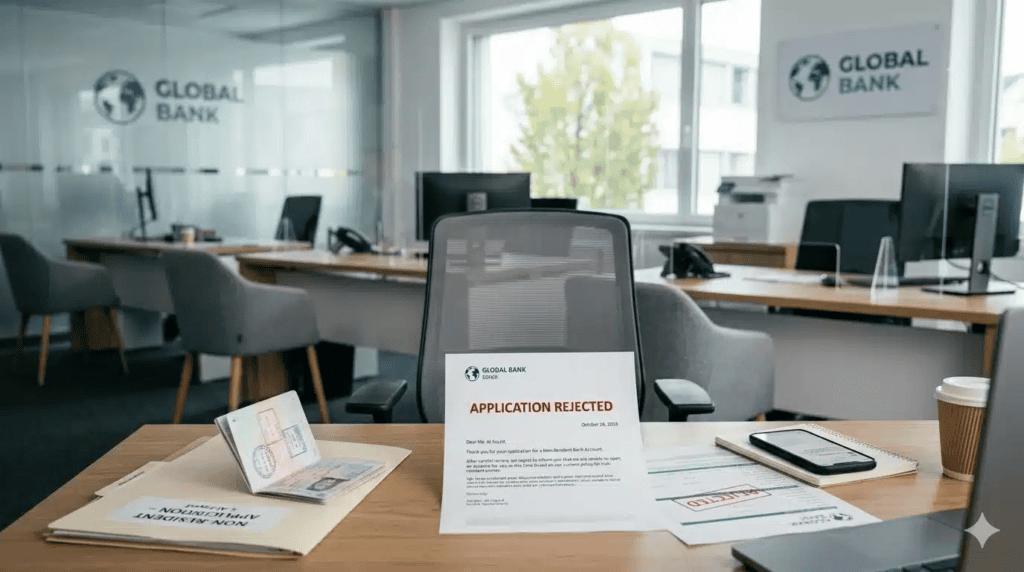
Two smaller factors matter too. Applying at three banks in the same week leaves a trail, and a declined application can follow you to the next one. Nationality also affects appetite: if your passport or your source of funds sits in a higher-risk category, expect more questions and a longer wait. That is how enhanced due diligence works, and it is not a judgement on you.
One thing to plan for after approval: an account that sits completely untouched will eventually go dormant, and reactivating one from abroad is far more work than keeping it lightly active. A small standing instruction each month is enough to avoid the problem.
Which option fits your situation?
If you are visiting and just want a card that works in shops and ATMs, open the ADCB tourist account. It costs almost nothing and takes minutes.
If you own property in the UAE or are buying, go traditional. You will need somewhere to pay service charges and receive rent for years, not months. Dubai Land Department runs a dedicated Emirates NBD account service for non-UAE residents, which is a cleaner starting point than a cold branch visit.
If you used to live in the UAE and still have money or business here, Emirates NBD and Mashreq are the usual choices, and an old customer record works in your favour.
If you work remotely and want a UAE base for invoicing, be careful. A personal non-resident account is not built for business income, and routing invoices through one invites questions you would rather avoid. A UAE company with a business account is the right structure, and it comes with a residence visa, which changes the whole picture.
If you are bringing a larger balance, RAKBANK Elite or a priority tier at Emirates NBD or ADCB gives you a relationship manager, and a named person inside the bank makes every later step faster.
Frequently asked questions
Can I open a UAE bank account without visiting the country?
No. Every route needs you in the UAE. The ADCB tourist account requires you to be physically present when you apply, and traditional banks need you at a branch to sign and show your original passport.
Do non-residents get a chequebook or credit card in the UAE?
No. Non-resident accounts are savings accounts, so there is no chequebook and no overdraft. A credit card is only possible if you secure it against a fixed deposit. Cheques and credit need a residence visa and an Emirates ID.
What is the lowest balance a non-resident can start with?
The ADCB Instant Tourist Account has no opening deposit, and AED 2,500 waives its AED 25 monthly fee. Traditional non-resident savings accounts usually start around AED 25,000 and climb from there depending on your profile.
How long does it take to open a non-resident account?
The tourist account is live in minutes. A traditional non-resident savings account takes roughly three to five business days after your branch visit, and longer if your income comes from a business or several countries.
Can I keep my UAE account after I leave the country?
Yes, with a traditional non-resident account, as long as you keep the minimum balance and update your documents when the bank asks. The ADCB tourist account is different: it closes when you exit the UAE or after six months.
Conclusion
For speed, ADCB’s Instant Tourist Account is the clear winner in 2026: minutes on your phone, no opening deposit, and a card that works across the UAE. For anything lasting, Emirates NBD, Mashreq and RAKBANK are the dependable options, and each expects a branch visit, a complete document file and a balance starting around AED 25,000. Work out which of the two you actually need, prepare the paperwork properly, and be ready to say plainly what the account is for.
Recommended Articles:
What Banks Offer Easy Corporate Accounts in Dubai?
Does UAE Allow Online Account Verification for Companies?
How to Open a Corporate Bank Account in the UAE — An Expert Guide