
You have your trade licence and your office lease, and the team is ready to operate. Then the bank requests “a few more documents”, and weeks go by.
Many UAE startups experience this. It is usually simpler to obtain the licence than it is to open a corporate bank account. By 2026, the banks will be stricter than ever and will examine compliance more thoroughly, look into ownership in greater detail, and pay more attention to whether the company has real substance in view of the introduction of corporate tax.
The good news is that most rejections and delays are due to poor planning, not a bad business. In this tutorial, HA Group outlines how startups can prepare documentation for establishing a bank account in the UAE so that the application goes through easily the first time.
Why UAE Banks Are Stricter With Startups in 2026
Before a banking relationship can be activated, UAE banks have to carry out Know Your Customer (KYC), beneficial ownership, and financial risk checks. This year, the three most important changes are:
- Stronger AML rules: The updated framework, which includes Federal Decree-Law No. 10 of 2025 and Cabinet Decision No. 134 of 2025, encourages banks to carry out greater due diligence, particularly when shareholders are foreign.
- Corporate tax and substance: Banks want to see real business activity, not a fake company.
- Digital onboarding: Banks now allow online uploads and UAE Pass verification. It’s quicker, but doesn’t allow for messy/inconsistent files.
Startups face an additional hurdle: no trading history. Your documentation needs to give the credibility that financial statements usually convey.
UAE Business Bank Account Requirements: The 5 Document Groups
The standards vary from bank to bank, however, almost all the banks in the UAE look at a startup’s paperwork in five areas. Your application will appear to be well organised and of low risk if all five categories have complete and consistent information.
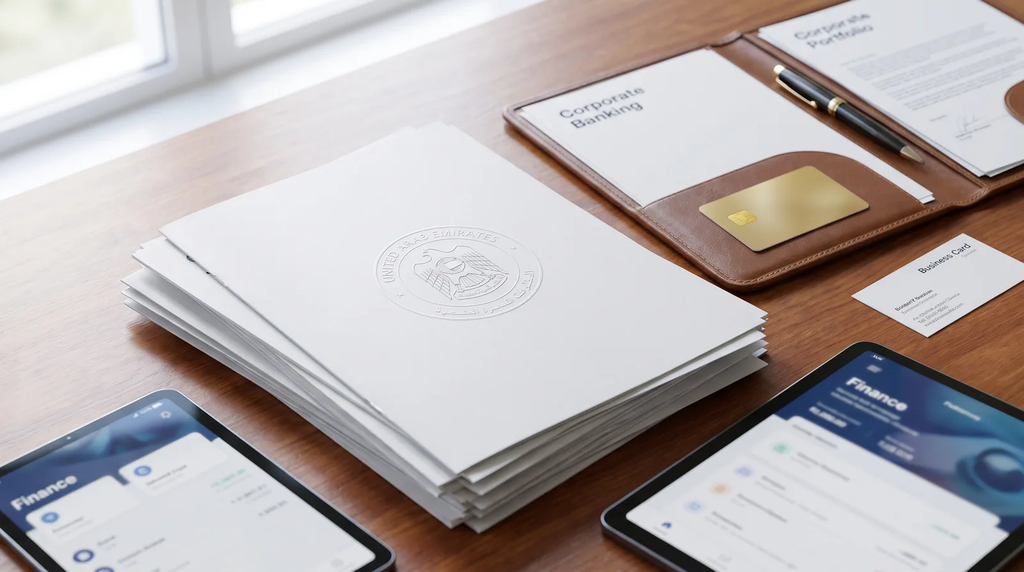
1. Corporate Documents
These are evidence that your business exists officially and can do what it says it can do.
- Valid trading license (Mainland, Free Zone or Offshore). Check the expiration date and that the licensed activities are in line with the actual business you’re running.
- The certificate of incorporation was issued by your licensing authority.
- Memorandum and Articles of Association (MOA/AOA). They show ownership, management rights and who can sign on behalf of the company.
- Share certificates showing your ownership in the MOA.
- Tenancy contract, Ejari, or flexi-desk agreement. This proves a registered business address. Many banks look closely at the address because they want to see a real presence in the UAE.
- Corporate Tax TRN and VAT certificate (if registered). A TRN shows the company is registered for corporate tax
Tip: Ensure the activity on your license is aligned with your genuine business strategy. A license with “software development” next to a plan on “general trading” raises eyebrows.
2. Personal KYC Documents
The banks examine each shareholder, director, manager, and authorised signatory separately.
- A copy of your passport valid for at least six months.
- UAE residents: Emirates ID and residence visa.
- Recent proof of address (utility bill, rental contract etc) Most banks require it within the previous 3 months.
- Professional Resume. This allows the bank to assess whether the founders have real expertise in the business.
- Personal bank statements (typically 6 months). This helps the bank to understand the financial history of each individual.
Scans should be colour and clear. A blurry or clipped copy is typically a request to resubmit and that costs days.
3. Ownership Proof
Banks have to know who really owns and runs the startup. This is most important for people who own 25% or more and are called Ultimate Beneficial Owners (UBOs).
UBO register filed with your licensing authority.
- A simple ownership structure chart. Show shareholders, percentages, directors, the signatories, and the final beneficial owners all on one page.
- KYC documents for each beneficial owner (same list as Group 2).
If the company is a shareholder, provide incorporation documents, registration of members and board data. They are generally required to be notarised and attested.
Why that matters: The main reason for delay are complex holding arrangements. If your structure contains layers or foreign entities, provide a brief cover note explaining why this is the case. A concise explanation leaves no ambiguity before the compliance team has to enquire.
4. Financial Documents
This group makes more decisions than any other. Your bank needs a clear legal route from the source of your money to your new account.
- Bank statements showing the funds. This statement should show where the money came from and how it was collected.
- Salary slips or employment letters; these suit founders who used their own savings to start the business.
- Sale agreements for property, shares, or a previous business. These explain large lump sums.
- Investor agreements or funding term sheets. These suit new businesses that get money from outside sources.
- Audited accounts or dividend records of previous companies. These suggest the money comes from corporate earnings.
Match the story to the paperwork. If you claim the capital comes from a property sale, you must provide the property sale agreement and the related bank deposit in the paperwork.
Avoid large unexplained cash deposits and transfers from unrelated third parties. Both raise compliance flags, even when the money is legitimate.
5. Business Documents
A startup does not have a trading history; your business profile needs to represent you. Make a concise plan, preferably two or three pages, covering:
- What you sell and to whom. There is a lot more power in “Cloud accounting software for small UAE businesses” than in “IT services.”
- Countries of your consumers and suppliers. That’s because banks check these against lists of sanctions and risks, so be honest and full.
- Turnover and transaction amount expected each month. Be honest with your predictions. Banks look at your predictions and the real action in your account later.
- Currencies and Major Payment Channels. Let us know if you anticipate bank transfers, card payments or internet platforms, and in which currencies.
It should be backed up by contracts that have been signed, purchase orders, quotes from suppliers, invoices, a live website, and a company email domain. This proof of content is just as important as the license itself in 2026.
Attestation and Translation: Don’t Leave It Late
Documents issued outside the UAE often need to be notarised, attested and legalised, especially corporate shareholder documents. Documents not in English or Arabic should be translated and verified.

You’ll need the bank’s own documents too.
- A board or shareholder resolution approving the account and naming signatories
- Completed account opening forms
- FATCA/CRS self-certification
- Specimen signature cards
Ask your bank for its templates first. Using the wrong format means redoing the work.
Your 4-Week Preparation Timeline
- Week 1: Collect and start attestation. Collect corporate and personal documents, verify expiration dates and commence attestation and translation of any foreign paperwork.
- Week 2: Build up the story. Prepare UBO chart, proof of source of funds and develop company profile with turnover and transaction estimations.
- Week 3: Review and choose. Write up the board resolution designating your signatories. Cross verify every name, date and activity across all files. Choose the banks that fit your activity and residence.
- Week 4: Complete and ready. Submit the application and get the founders ready for the compliance interview. Know your company concept, clients, countries and source of cash well enough to be able to discuss them without notes.
Common Mistakes That Delay Account Opening
- Submitting expired passports, IDs or licences.
- Showing various business names or shareholding percentages on papers.
- Describing activities vaguely, such as “general trading.”
- Overstating turnover projections.
- Ignoring the bank’s requests for extra information.
- Applying to several banks with different stories.
- Arriving at the KYC interview unprepared.
Traditional Bank or Digital Bank?
Traditional banks like RAKBANK, Mashreq, ADCB, and Emirates NBD provide all services; however, they may require in-person meetings and higher minimum balances.

Digital business banks, including Wio Business and Mashreq NeoBiz, offer faster online onboarding and lower minimum balances, which are good for lean free zone businesses and freelancers.
Please match your activity, residence and budget to the proper bank before you apply.
How HA Group Helps Startups Open UAE Bank Accounts
First, prepare the documents. Then, apply. This is the basis of our service. At HA Group, we compile your whole document file, review each document for consistency, manage attestation and develop a bank-ready company profile that addresses compliance concerns before they are ever asked. We also connect you with banks that welcome your activity and prepare you for the KYC interview.
Are you looking to open a UAE business bank account without delays? Call HA Group now for a free consultation.
FAQs
What documents are needed to open a business bank account in the UAE?
Most banks ask for a valid trade licence, incorporation documents, MOA/AOA, passport and Emirates ID copies for all shareholders and signatories, UBO details, proof of address, evidence of the source of funds, and a business plan. Exact requirements vary by bank and company profile.
Can a startup open a UAE bank account without financial statements?
Yes. Instead, Banks often want a business strategy, contracts, invoices, estimated turnover and proof of source of money.
How long does bank account opening in UAE take?
This normally takes between 2 and 6 weeks, but there is no fixed timeline. The process depends upon the bank and how complete your documentation is.
Can non-resident founders open a UAE business account?
Yes, but be ready for tighter due diligence. Many banks want at least one member to be from the UAE.
Is there a minimum balance requirement?
It’s different. Some digital banks don’t ask for much or anything at all, but standard banks may ask for AED 10,000 to AED 50,000 or more.
Recommended Articles:
Is It Difficult to Open a Corporate Bank Account in the UAE?
Can Non Residents Open Bank Accounts in Dubai?
Are offshore companies eligible for UAE banking?
Where to Submit a UBO Declaration for a Corporate Bank in the UAE?